

The question of how our universe began has fascinated scientists and philosophers for centuries. In 1927, Belgian physicist and priest Georges Lemaître proposed that the universe originated from a single “primeval atom” that exploded to create space, time, and an expanding cosmos, a concept that would later become known as the Big Bang theory. Yet direct evidence for this theory didn’t emerge until nearly four decades later, thanks to a surprising discovery at Bell Labs.
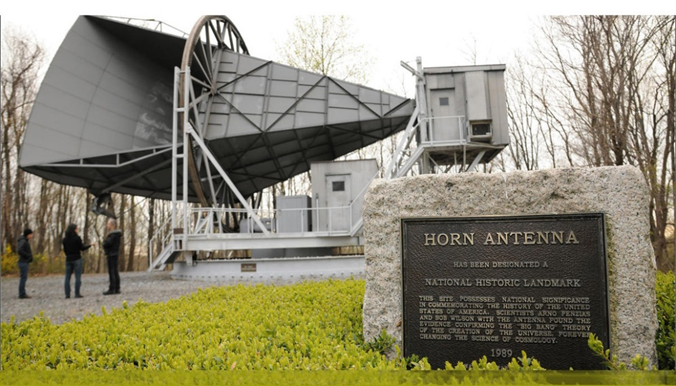
In 1964, researchers Arno Penzias and Robert Woodrow Wilson were conducting radio astronomy experiments using a highly sensitive horn antenna at Bell Labs’ Holmdel, New Jersey campus. Originally built for NASA’s Project Echo, the antenna was designed to detect faint radio signals from space. While mapping signals from the Milky Way, the scientists encountered a persistent, low-level buzzing noise. Despite meticulously checking for interference, they couldn’t explain the source.
It turned out that the mysterious signal was cosmic microwave background radiation, a remnant of the early universe. This accidental discovery provided strong evidence supporting the Big Bang theory and earned Penzias and Wilson the 1978 Nobel Prize in Physics. Beyond its astronomical significance, the work also advanced non-terrestrial communication technologies with applications in satellite communications and disaster relief.

The Holmdel horn antenna and its associated projects, Project Echo, Telstar, and the discovery of cosmic microwave background radiation, were recently recognized as an IEEE Milestone. A dedication ceremony was held at Wilson Park in Holmdel, with the plaque commemorating the site’s role in shaping our understanding of the universe. Importantly, the IEEE Photonics Society, alongside the IEEE New Jersey Coast Section, sponsored the Milestone nomination, highlighting the Society’s commitment to celebrating breakthroughs in photonics, communications, and scientific discovery.
The Milestone program, administered by the IEEE History Center, honors technical achievements that have had a lasting impact globally. With the support of local communities, the Holmdel antenna is preserved not only as a historic site but also as a symbol of how careful experimentation, and sometimes serendipity, can expand humanity’s understanding of the cosmos.
Read the recent IEEE Institute article, “Bell Labs Scientists Accidentally Proved the Big Bang Theory,” to learn more.
Feature photo: In 1964, researchers at Holmdel, N.J., noticed a persistent buzzing on the Horn Antenna; this signal was cosmic microwave background radiation, supporting the Big Bang theory. – NASA