

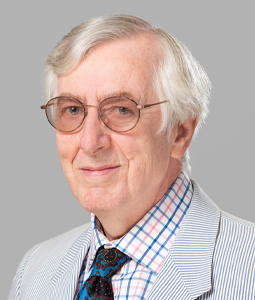
For pioneering developments in microwave photonic devices and systems, leading to successful commercialization of wireless-over-fiber for 5G+ cellular communication.
Alwyn Seeds holds the B.Sc, Ph.D. and D.Sc. degrees of the University College, London. After working as a Staff Member at Lincoln Laboratory, Massachusetts Institute of Technology and as Lecturer in Telecommunications at Queen Mary College, University of London, he joined University College London in 1986, where he is currently Professor of Opto-electronics, Head of the Photonics Group and Director of the EPSRC National Dark Fibre Facility. He has published more than 500 papers on microwave and opto-electronic devices and their systems applications, of which some 100 have been invited.
Professor Seeds is a Fellow of the Royal Academy of Engineering (UK), an IEEE Life Fellow (USA) and has served as Vice-President for Technical Affairs of the IEEE Photonics Society (USA). He co-founded Zinwave, a manufacturer of wireless over fibre systems, now a unit of Wilson Electronics LLC. There are now over 850 Zinwave systems installed in 26 countries worldwide. Alwyn Seeds was awarded the Gabor Medal and Prize of the Institute of Physics in 2012 and the Distinguished Educator Award of the IEEE Microwave Theory and Techniques Society in 2018.
| Year | Award Winner | Citation |
|---|---|---|
| 2022 | Ulrich L. Rohde | For outstanding engineering achievement in the field of optoelectronic signal generation and optical measurement equipment for next-generation intelligent optical networks. |
| 2021 | José Capmany | For pioneering and sustained contributions to integrated microwave and programmable photonics including the invention of Field Programmable Photonic Gate Arrays. |
| 2020 | George C. Papen | For contributions to optical systems, especially optical switching in data center networks. |
| 2019 |
Holger Schmidt
Aaron Hawkins |
For the invention and development of optofluidics waveguides and their applications, in particular, commercialization for biomedical diagnostics. |
| 2018 | Dalma Novak | For the creation and development of breakthrough technologies for the microwave photonics field, in particular for fiber-radio communication systems. |
| 2017 | David V. Plant | For pioneering contributions to optical communications technologies spanning multiple length scales including DSP algorithms for direct detection and coherent systems. |
| 2016 | Keren Bergman | For pioneering contributions to optical interconnection networks and photonic-enabled architectures that advance communicaitons and computing systems. |
| 2015 | Chennupati Jagadish | For pioneering and sustained contributions to compound semiconductor quantum well, quantum dot and nanowire optoelectronic devices and their integration. |
| 2014 | Yong-Hee Lee | For pioneering research on the photonic crystal nanolaser and the proton-implant vertical cavity surface emitting laser. |
| 2013 | Polina Bayvel | For seminal advances in optical networks, including efficient wavelength routing architectures and electronic DSP algorithms to mitigate degrading effects. |
| 2012 |
Gregory Belenky
Jerry Meyer
Igor Vurgaftman |
For exceptional contributions to the technology of mid-wave GaSb-based infrared lasers. |
| 2011 | Alan Willner | For technical advances in optical fiber communications technologies that have enabled significant improvements in the performance and reliability of wavelength-division-multiplexed systems. |
| 2010 | Wood-Hi Cheng | For design, development and commercialization compact solid-state laser modules. |
| 2009 | Jose A. R. Salcedo | In recognition of outstanding technical and leadership contributions to pulsed fiber lasers, in particular all-fiber ring laser architectures, and of his pioneering efforts aimed at developing, promoting and commercializing this technology in Portugal – and later in international markets. |
| 2008 | Kent D. Choquette | For development of the monolithic selectively oxidized vertical cavity surface emitting laser. |
| 2007 |
Andreas Umbach
Gunter Unterborsch
Dirk Trommer |
For the research, development and fabrication of advanced ultra-high speed photodetectors. |
| 2006 |
John H. Marsh
A.Catrina Bryce |
For extensive development and commercialization of quantum well intermixing for photonic devices. |
| 2005 |
Chung-En Zah
Rajaram Bhat |
For pioneering work on the AlGaInAs/InP strained quantum well lasers for uncooled applications. |
| 2004 | Marina M. Meliga | For pioneering work on the development of semiconductor lasers and for the design and development of uncooled DFB lasers for datacom applications. |
| 2003 | Dennis Deppe | For sustained contributions and innovations in the area of oxide confined and quantum dot vertical cavity surface emitting lasers. |
| 2002 | Timothy Day | For contributions to the development and commercialization of external cavity tunable diode lasers for telecommunications, spectroscopy, metrology, and biotechnology. |
| 2000 |
Pallab Bhattacharya
Sethumadhavan Chandrasekhar
Leda Lunardi |
For design and development of high-performance 1.55um opto-electronic integrated photoreceivers. |
| 1999 | Frederick Kish, Jr. | For seminal contributions to high performance light-emitting diode technology and production. |
| 1998 | David F. Welch | For the design, development and commercialization of high power diffraction limited semiconductor lasers. |
| 1997 |
Corrado Dragone
Meint K. Smit |
For the conception, design, and reduction to practice of novel optical waveguide array devices, and their application to WDM networks. |
| 1996 |
Isamu Akasaki
Hiroshi Amano
Shuji Nakamura |
For the technology breakthrough of making p-type gallium nitride, demonstrating very bright blue light emitting diodes, and developing a commercial LED product which is expected to have major impact in the display and other optoelectronic industries. |
| 1995 |
P. Daniel Dapkus
Russell D. Dupuis |
For pioneering work on the engineering of MOCVD technology for semiconductor lasers. |
| 1994 | Donald R. Scifres | For the development and commercialization of high power semiconductor lasers and their applications. |
| 1993 |
Won T. Tsang
Hauro Tanaka |
For the development and manufacturing of AlGaAs diode lasers for compact disc applications by MBE. |
| 1992 | Peter K. Runge | For key contributions to the development of undersea lightwave systems. |
| 1991 | Michiharu Nakamura | For pioneering work and commercialization of high-performance narrow-linewidth semiconductor lasers for optical communications. |