

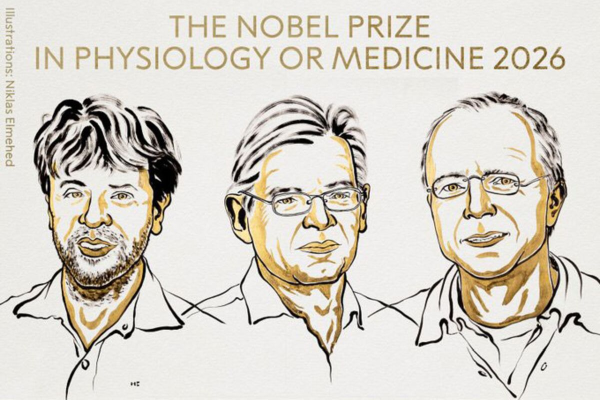
The 2026 Nobel Prize in Physiology or Medicine offers a powerful reminder that some of the most transformative advances in human health begin with something fundamental: understanding and harnessing light.
On 5 October, the Nobel Assembly at Karolinska Institutet awarded the 2026 Nobel Prize in Physiology or Medicine to Karl Deisseroth, Peter Hegemann, and Georg Nagel for their discoveries concerning light-gated ion channels and optogenetics. Their pioneering work established a way to use light to control the activity of specific nerve cells, transforming neuroscience and giving researchers unprecedented tools for investigating how the brain shapes memory, emotion, behavior, and disease.
For the global photonics community, recognition carries particular significance. At its heart, optogenetics demonstrates what becomes possible when the properties of light are combined with biology, engineering, and medicine to address some of humanity’s most complex challenges.
From Light-Sensitive Algae to the Living Brain
The origins of optogenetics began far from the human brain. Peter Hegemann studied how Chlamydomonas, a single-celled alga, responds and moves toward light. Together with Georg Nagel and other collaborators, this research led to the identification and characterization of channelrhodopsins, proteins that function as light-gated ion channels. When exposed to particular wavelengths of light, these proteins allow charged ions to pass through the cell membrane, creating an electrical response.
That discovery provided an extraordinary opportunity: if the gene responsible for a light-sensitive protein could be introduced into another type of cell, perhaps that cell could also be controlled using light.
Karl Deisseroth and his collaborators brought that concept into neuroscience. In 2005, his team demonstrated that channelrhodopsin could be introduced into neurons and used to control their electrical activity with light. The approach ultimately made it possible to activate specific neurons in the brains of living animals with remarkable spatial and temporal precision.
The field became known as optogenetics.
Instead of simply observing which parts of the brain become active during a particular behavior, researchers could now use precisely delivered light to activate or inhibit selected neural circuits and investigate their function.
The Nobel Committee described the result as the beginning of a new era in neuroscience. Optogenetics has since helped researchers investigate neural circuits associated with memory, movement, emotion, behavior, and neurological and psychiatric disorders. Researchers are also exploring clinical applications, including approaches intended to restore vision for people with visual impairment.
When Photonics Becomes a Tool for Discovery
The 2026 Nobel Prize also illustrates the increasingly interdisciplinary nature of photonics.
Optogenetics sits at the intersection of photonics, neuroscience, molecular biology, genetics, bioengineering, and medicine. Its development required not only biological discoveries but the ability to generate, deliver, manipulate, and control light with the precision necessary to interact with living cells.
Lasers, LEDs, optical fibers, microscopy, imaging systems, miniaturized optical components, and increasingly sophisticated photonic technologies have all helped expand what researchers can accomplish with optogenetic techniques.
As these technologies continue to advance, so does the ability to deliver light deeper, more precisely, and to increasingly complex biological environments. Research involving nanophotonic probes, integrated emitters, advanced microscopy, holographic illumination, and other optical technologies is continuing to expand the possibilities for studying neural systems.
This is one of photonics’ defining strengths: light is not only something we observe. It is something we can engineer into a tool for understanding and interacting with the world around us.
Advancing Technology for the Benefit of Humanity
The journey from studying how algae respond to light to controlling individual neural circuits also demonstrates why fundamental research matters. Hegemann and Nagel’s investigations were rooted in curiosity about a basic biological phenomenon. The eventual application of those discoveries to neuroscience could not have been fully predicted at the outset. Yet when researchers from different disciplines connected those discoveries with new technologies and new questions, an entirely new scientific field emerged.
That progression, from fundamental discovery to enabling technology to real-world human impact, is central to the work of the IEEE and IEEE Photonics Society.
Our community exists not only to advance photonics itself, but also to create environments in which knowledge can move across disciplines. The Nobel recognition of optogenetics is a compelling example of what can result from that type of interdisciplinary thinking.
There is still much to learn about the human brain, and many challenges remain before optogenetic approaches can be translated broadly into clinical medicine. But technology has already changed how researchers investigate one of the most complex systems known to science.
More precise light delivery miniaturized and integrated optical systems, advanced imaging, new light-sensitive molecules, computational methods, and emerging biophotonic technologies could enable researchers to investigate biological systems at scales and levels of precision that were once unimaginable.
The IEEE Photonics Society congratulates Karl Deisseroth, Peter Hegemann, and Georg Nagel on this remarkable recognition and celebrates the scientists, engineers, and interdisciplinary communities whose continued innovations in light are helping transform our understanding of the world, and improve lives through technology.