
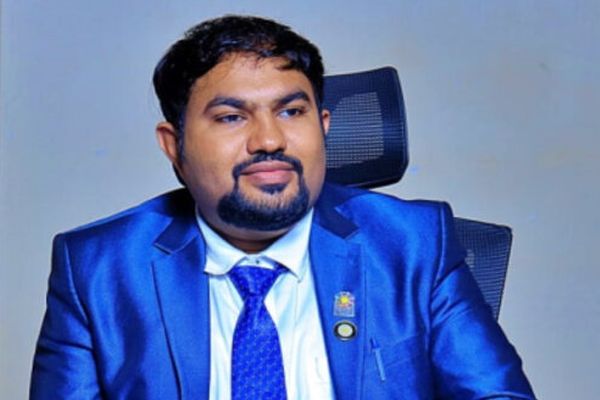
In this edition of our Senior Member spotlight, we feature Mayur Chippa, Vice Chair of the IEEE Uganda Section and Head of the Engineering and Open, Distance and e-Learning (ODeL) Department at ISBAT University in Kampala, Uganda.
This Senior Member series celebrates the achievements, experiences, and contributions of IEEE Photonics Society members who demonstrate professional excellence, leadership, and a commitment to advancing the global engineering and photonics community. Through Q&A-style interviews, the series offers insight into senior members’ career journeys, volunteer service, and professional development, while highlighting their perspectives on emerging opportunities in the field.
By sharing these stories, we aim to recognize individuals making a meaningful impact, inspire members at different stages of their careers, and encourage greater engagement, mentorship, and leadership across the IEEE community.
What innovative work, research, or initiatives are you currently involved in that are making an impact within the photonics community (technical, educational, outreach, industry, and/or community-based)?
My current work focuses on advancing photonic integrated circuits (PICs) while building a stronger photonics ecosystem through research, education, outreach, and international collaboration. My research investigates compact photonic crystal-based passive devices, including optical filters, switches, logic gates, encoders, and sensors for next-generation optical communication networks, AI-enabled data centers, Microwave photonics, and emerging 6G communication systems. I am also expanding this work toward microwave photonics, quantum technologies, and photonic chip development through collaborations with researchers and institutions worldwide.
Beyond research, I am committed to developing photonics capacity across Africa. Through IEEE Photonics Society, IEEE MTT-S, IEEE CASS, IEEE Computer Society, and IEEE Uganda Section, I have organized International Day of Light celebrations, photonics workshops, distinguished lectures, and hands-on optical fiber and photonic design training for students, researchers, and industry professionals. As Head of Engineering at ISBAT University, I mentor undergraduate projects, masters projects, co-supervise PhD scholars, and integrate simulation-based photonics education using tools such as OptiFDTD and Lumerical to bridge theory with practical design.
I actively promote international collaboration by delivering keynote lectures, faculty development programs, and invited talks on photonic integrated circuits, photonic chips, and future optical communication technologies across Africa, Asia, and Europe. My efforts aim to strengthen research networks, inspire young researchers, and create pathways between academia and industry. Through these combined initiatives, I strive to make advanced photonics research more accessible, application-oriented, and impactful for both the global scientific community and emerging innovators.
What challenge or problem do you aim to address through your work, and why is solving it important to the future of photonics or society as a whole?
The primary challenge I aim to address is the growing gap between the increasing demand for ultra-high-speed, energy-efficient communication systems and the limitations of conventional electronic technologies. As artificial intelligence, cloud computing, quantum technologies, and 6G communications continue to evolve, existing electronic interconnects face significant constraints in bandwidth, latency, power consumption, and scalability. My research focuses on advancing photonic integrated circuits (PICs), microwave photonics, and photonic crystal-based devices to enable compact, high-performance optical components that support next-generation communication networks and AI-driven data centers.
Beyond technical innovation, I am equally committed to addressing the shortage of photonics expertise in emerging economies, particularly across Africa. Through IEEE Photonics Society, IEEE MTT-S, and ISBAT University, I organize international workshops, distinguished lectures, hands-on training programs, and outreach initiatives that introduce students, educators, and young researchers to photonics and integrated optical technologies. My goal is to create sustainable research capacity, strengthen academia-industry partnerships, and inspire future innovators to contribute to this rapidly evolving field.
Solving these challenges is essential because photonics will underpin future technologies in communications, healthcare, sensing, quantum information, autonomous systems, and sustainable computing. By combining impactful research with education, mentorship, and international collaboration, I aim to accelerate the adoption of photonic technologies while ensuring that developing regions actively participate in shaping the future of the global photonics ecosystem, fostering innovation, economic growth, and societal development.
What impact has your work had so far on students, researchers, industry, communities, the general public, or broader scientific ecosystem you serve?
My work has contributed to the photonics community by integrating high-impact research, education, professional service, and international collaboration. Through my research on photonic integrated circuits, photonic crystal devices, and microwave photonics, I have published in leading journals and conferences, while serving as a reviewer for several IEEE, SPIE, Elsevier, Springer, Wiley, and MDPI publications. These contributions help advance knowledge in optical communications, integrated photonics, and emerging technologies for AI-driven data centers and future 6G networks.
As an educator and mentor, I have supervised undergraduate, masters research projects, co-supervised PhD scholars, and guided students in photonics, optical communications, artificial intelligence and advanced simulation tools. Many of my students have developed strong research skills, presented at conferences, and pursued higher studies and professional careers in engineering and technology. Through IEEE student activities, I have encouraged young engineers to actively participate in research, innovation, and professional networking.
My outreach efforts have significantly expanded awareness of photonics across Africa. By organizing IEEE Photonics Society events, International Day of Light celebrations, webinars, workshops, and distinguished lectures, I have connected students, academics, and industry professionals with global experts, creating opportunities for collaboration and knowledge exchange. These initiatives have strengthened regional research networks and inspired greater participation in photonics-related activities.
Receiving recognition in The Photonics 100 has further amplified the visibility of my work and reinforced my commitment to advancing photonics research, education, and community engagement. My long-term objective is to build an inclusive, globally connected photonics ecosystem that drives scientific innovation, technological progress, and sustainable societal development.

How do you engage, mentor, motivate, or inspire others through your professional work, volunteer service, or leadership activities?
Throughout my academic and professional journey, I have viewed mentorship and leadership as essential responsibilities alongside research. As Head of Engineering at ISBAT University and an active IEEE volunteer, I strive to create opportunities that empower students, early-career researchers, and young professionals to pursue excellence in photonics, microwave engineering, and emerging technologies. My mentoring approach combines technical guidance, career development, and continuous encouragement, helping individuals build confidence and develop an innovative mindset.
I actively supervise undergraduate research projects and co-supervise PhD scholars, encouraging interdisciplinary research in photonic integrated circuits, optical communications, AI, and next-generation communication systems. Beyond the classroom, I organize technical workshops, webinars, distinguished lectures, hackathons, and International Day of Light celebrations through IEEE Photonics Society, IEEE MTT-S, and IEEE Uganda Section. These initiatives expose participants to global experts, cutting-edge technologies, and international research collaborations while fostering practical skills and professional networking.
As an IEEE leader – Vice Chair IEEE Uganda Section, I have worked to establish stronger connections between academia, industry, and professional societies, particularly across Africa. I actively support the formation of IEEE Student Branch Chapters, encourage volunteerism, and mentor young engineers to take leadership roles within IEEE and their institutions. By promoting collaboration, inclusivity, and lifelong learning, I aim to inspire the next generation of scientists and engineers to address real-world challenges through photonics and engineering innovation.
My greatest motivation comes from seeing students and colleagues grow into confident researchers, educators, innovators, and leaders who will contribute meaningfully to the advancement of science, technology, and society.

What first drew you to the field of photonics? Was there a defining moment, experience, mentor, or inspiration that led you to pursue this path?
My journey into photonics began during my postgraduate studies, when I attended several national conferences on optics and photonics across India. These events introduced me to the remarkable potential of light as a medium for communication, sensing, and computation. A defining moment came when I attended an inspiring keynote lecture by Prof. Raghunath Shevgaonkar, IIT Mumbai, then Director of IIT Delhi. His vision for optical communication and photonics as transformative technologies convinced me that this field would shape the future of global connectivity and scientific innovation.
As I continued my academic journey, I was fortunate to learn from and be inspired by several distinguished researchers whose mentorship profoundly influenced my career. My PhD supervisor, Dr. B. T. P. Madhav, KL University, nurtured my research interests in photonic integrated circuits and optical communications. I also benefited from the guidance and inspiration of Dr. S. K. Varshney (IIT Kharagpur), Dr. Vijay Janyani (MNIT Jaipur), Prof. Ajoy Ghatak, Prof. Joby Joseph, Prof. Bishnu P. Pal, and Prof. Anurag Sharma (IIT Delhi), along with internationally renowned pioneers including Prof. Eli Yablonovitch and Prof. Benjamin Eggleton. Early encouragement from Dr. Rekha Mehra and Dr. Lalit Dusad at Government Engineering College, Ajmer, further strengthened my passion.
These experiences transformed my curiosity into a lifelong commitment to advancing photonics research, education, innovation, and global collaboration for societal benefit.
What emerging area, technology, or application in photonics excites you the most right now, and how do you see your work contributing to the future of the field?
The emerging area of photonics that excites me most is the convergence of photonic integrated circuits (PICs), microwave photonics, artificial intelligence, and quantum photonics to enable next-generation computing and communication systems. As AI-driven data centers, 6G networks, and quantum technologies continue to evolve, photonics will play a pivotal role in delivering ultra-high bandwidth, low latency, energy-efficient processing, and scalable optical interconnects. I believe this convergence represents one of the most transformative opportunities for both science and society.
My research contributes to this vision by developing compact photonic crystal-based devices and integrated photonic components for optical communications and high-speed signal processing. I am particularly interested in designing photonic solutions for AI-enabled data centers, microwave photonic systems, and future optical transceivers that address the growing demands for speed, energy efficiency, and computational performance. Looking ahead, I also aim to contribute to photonic chip development and quantum photonic technologies through interdisciplinary and international collaborations.
Equally important is my commitment to building the next generation of photonics researchers. Through my leadership in IEEE Photonics Society, IEEE MTT-S, and academia, I promote education, mentorship, and global collaboration, particularly across Africa. By combining impactful research with capacity building and international partnerships, I hope to accelerate the adoption of integrated photonics while ensuring that emerging regions actively contribute to the future of photonics innovation, technological advancement, and sustainable global development.
What’s a message or insight you wish more senior leaders would consider from early-career professionals?
One message I would like to share with senior leaders is that early-career professionals are not just the future of photonics—they are already active contributors to its progress. Given meaningful opportunities, mentorship, and trust, young researchers can bring fresh perspectives, interdisciplinary thinking, and innovative solutions to some of the field’s most pressing challenges. Investing in their potential today will strengthen the scientific community for decades to come.
I encourage senior leaders to create more inclusive environments where young professionals are empowered to lead projects, participate in decision-making, and engage in international collaborations. Constructive mentorship should extend beyond technical guidance to include career development, leadership opportunities, networking, and encouragement to take calculated risks. Recognition of emerging talent, regardless of geographical location or institutional resources, is equally important to ensure that innovation is driven by merit and diverse perspectives.
As someone who has benefited greatly from the mentorship of distinguished researchers and IEEE volunteers throughout my career, I understand the transformative impact that guidance and encouragement can have. I now strive to provide the same support to students, researchers, and young professionals through teaching, mentorship, and volunteer leadership.
By fostering collaboration across generations and empowering early-career researchers to lead with confidence, the global photonics community can accelerate innovation, broaden participation, and develop sustainable solutions that benefit science, industry, and society for years to come.
Is there a book, paper, mentor, resource, or experience that has significantly influenced your career or perspective and that you would recommend to others?
I have been profoundly influenced by mentors including Prof. Raghunath Shevgaonkar, Prof. Ajay Ghatak, Prof. Eli Yablonovitch, Dr. B. T. P. Madhav, Dr. S. K. Varshney, Dr. Vijay Janyani, Prof. Joby Joseph, Prof. Bishnu P. Pal, Prof. Anurag Sharma, and Prof. Benjamin Eggleton, whose research and guidance shaped my journey in photonics. I also highly recommend engaging with the IEEE Photonics Society through its journals, particularly IEEE Photonics Journal, IEEE Journal of Selected Topics in Quantum Electronics, and IEEE Photonics Technology Letters, as well as attending IEEE Photonics Society conferences to stay connected with cutting-edge research, collaboration, and innovation.
What does being recognized as an IEEE Photonics Society Senior Member Member Spotlight honoree mean to you personally and professionally?
Being recognized is both a tremendous personal honor and a meaningful professional milestone. It reflects not only my research contributions in photonic integrated circuits, AI, and optical communications but also my commitment to education, mentorship, IEEE volunteerism, and building photonics capacity across Africa. This recognition motivates me to continue advancing innovative research, fostering international collaborations, and inspiring the next generation of scientists and engineers. I view it as a responsibility to serve the global photonics community with greater dedication while promoting inclusive growth, innovation, and excellence in photonics worldwide.
What is a fun fact, hobby, passion, or personal interest that colleagues and peers might be surprised to learn about you?
Outside of research, I enjoy exploring new places, meeting people from diverse cultures, and participating in community and IEEE volunteer activities. Traveling for conferences has become a way for me to learn not only about cutting-edge photonics research but also about different cultures, universities, and innovation ecosystems around the world. I am also passionate about mentoring young researchers and helping them discover opportunities in science and engineering. Colleagues are often surprised to learn that I find as much fulfillment in building research communities and inspiring future engineers as I do in publishing research papers or developing new photonic technologies.